“Reading Loop” is a close reading or discussion by an invited contributor.
Writing Processes, Imposter Syndrome, and My Need to Make Sense
by Rachael A. Zubal-Ruggieri
“We regret to inform you that your contribution is still not ready to be included.”
~cryptic feedback on unpublished manuscript“… [your essay] isn’t quite right for our current needs…”
~vague commentary on unpublished essay“We’re going to decline on participating in this book.”
~response to a permission request”…your overall final piece veered abruptly from topic to topic”
~disappointing feedback on a writing assignment
One of these quotes is not like the others. Can you decipher which one? Still, most of the above terse comments were in response to works submitted for publication that were ultimately rejected. I pull out these dismissive remarks and reread them far more often than I should. Every time I scan them, I feel equal parts dejected and embarrassed. But I also feel affronted.
For the longest time, I couldn’t seem to reconcile the mixed emotions such rejections evoked, because the comments aren’t outright lies; there is some truth to them. Yes, maybe the writing needed more work. Perhaps the sentences and paragraphs needed more coherence and structure, and so on. Simply put, nearly all these responses simply haven’t offered enough constructive criticism (if any at all) to adequately address any concerns; almost none of them include helpful feedback. When might my writing ever be “ready”? What would make any writing “right”? How might I reorganize my thoughts, pull things together, create something “readable” and coherent? While the writing may diverge from point to point, is it good? What, if anything, might be “acceptable”?
These internal rhetorical questions emerge in response to such rejections. More often than not, I don’t find answers that satisfy me. I forge ahead regardless.
I may never revise any of these rejected manuscripts or explore concrete answers. Instead, I flip a switch. I shift gears, coping in one of the only ways I know how: I turn inward. I engage in alternative creativity, composing new verse (and, yes, periodically reworking previously rejected writing) and more. I do “this” in ways that help me process and progress. I seek. I find. I keep. But I never lose, not really. How to (re)start, though?
I received a link in my email inbox recently that seemed interesting and had a relatively innocuous title: “From the Inside Out: My Disability.” I clicked on the link and began to skim the text. I smiled wryly after reading the first paragraph, and the subsequent single line that followed (emphasis added):
I’ve sat down to write…a frustratingly large number of times, and have found myself unable to figure out how to start. This confused me immensely because when I first applied to write a column about disability, I was filled with the desire to write. I had so many thoughts about my experience with disability, and how it has been shaped not only by my disability itself but by my environment’s reaction to it.
So, what happened? Is this just writer’s block?
Dunning Kruger effect (how one with experience might underestimate their expertise) strikes again. Or rather Baader-Meinhof phenomenon (a frequency illusion or cognitive bias, where the same concept suddenly appears over and over everywhere). Is it a coincidence that this email suddenly appeared when it did? Maybe. All I know now is that I’m not the only one, as the excerpt above underscores. I indeed perseverate about where to begin at times. I’ve discovered a number of ways to approach these creative roadblocks, especially after rejection, and they are unique and varied.
Madness in the Method
I have so many mechanisms and methods I use to soothe my Mad brain after rejection. They are scattered (and yes, they “veer abruptly”) and ultimately I can break away from being stuck. I utilize theories and analysis; I consider symbolism, analogy, metaphor, and more—any number of these methods or syntheses have resulted in prompts, exercises, and formats that both ground me and serve as a catalyst. Some of these are my own creations, some are inspired or shared by others.
I continuously bookmark online resources as well as numerous Tumblr blog posts offering creative writing prompts, often with a fantastical or paranormal slant. I take screenshots with content that tickles my brain. I save memes and Instagram comics that replicate my ideas while more than adequately expressing my joys and frustrations. I email myself sentences, quotes, and resources so I don’t lose them. I enroll in writing retreats and sign up for daily writing prompts. I carry notebooks and pens everywhere I go. I record voice memos on my phone (even if I hate the sound of my voice).
If I can’t do any of the above (like when I am driving), I repeat the words, phrases, or ideas over and over again out loud until I can document them somehow. Periodically, as I stop and sit at red lights, I scramble to find a way to document random thoughts, any number of which pop into my head. I start scribbling on the back of junk mail or at the bottom of other papers that are nearby. Many of my approaches involve wordplay and earworms. I harness these techniques to create my constrained, yet meaningful poetry-snippets—my Micro Mutant (Memoir) Postcards—and more.
Imposter Syndrome is Real
What a mess I have made with nothing but an idea that I am not enough.
~Chloe Frayne
I must admit I have an irrational, rampant fear of an empty page, as well as all the baggage intertwined with that emptiness (and pressure). Do I create something new? Do I start over? If so, how? For a long time, this fear has been my own worst enemy (in some respects, it still is). But then that began to change. Wait, back up. Perhaps I’m not stating clearly enough how much I used to doubt myself and as a result, I was stuck on where and how to write.
I circle back to my problem. How can I address feelings of self-doubt? To get back on the proverbial saddle? I read. I learn. I play.
I use comparison, particularly analogy. I also use various figures of speech, metaphor primarily among them. Homonyms are another way I tinker with ideas and words. Sometimes I make up words.
I’ve attended workshops, registered for days-long conferences, enrolled in writing retreats, and set reminders on my calendar to designate blocks of time for me to write. I also think the worst of myself. I hesitate, overthink, become immovable. During my exploration, I’ve discovered so many other ways to say the same thing: imposter syndrome; self-gaslighting; self-sabotage; and yes, internalized ableism. All fall right in line with that folding in on myself that I experience upon rejection. Am I an imposter? It certainly feels that way sometimes.
Mechanisms, attitudes, and approaches aside, I don’t just write for the sake of writing; I process. I sometimes group or clump words together, those that might not usually “fit” together but may be vaguely connected, beyond their literal meaning (or how they sometimes sound, bounced off each other?). Those are my two cents. Does that make sense? I hope so.
I’ve created a unique bricolage, fabricated using a series of systems and constructs–some embodied, others, diagrammatic–and often evoking popular culture or my own memories.These forms I create lead into other outlets. The cycle is never ending.
Peaks and Valleys, Dogs and Cats: Can I Answer a Question with a Question?
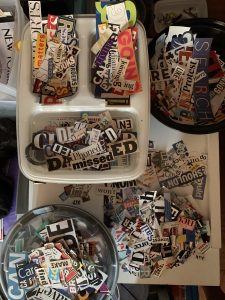
I do take a break from writing periodically, in order to refresh myself, prose-wise. It’s often easier said than done, but I simply put any ongoing work aside (both literally and figuratively) and leave the writing alone for a while. When I spend time doing something else, I might come back to writing with something new and different to explore. I might return to my data, supplement the content, find a glaring error that needs to be fixed, or amaze myself at what I’ve written. I have Peak Days, I have Valley Days. I have Dog Days, I have Cat Days.
I’ve begun a project that offers me yet another creative outlet, one that involves reusing a range of materials, overlaying images and other media, sorted and recycled, and pasted together to create new works. These words and images are mostly cut out from National Geographic Magazine, but arise from other magazines as well, including People, The New Yorker, New York Magazine, and Woodworking.
My plan is to repurpose my massive collection of physical postcards (and nearly every greeting card I’ve ever received) by creating collages, visual poetry, and more. Each work will be limited to the standard size of a 4 inch by 6 inch postcard. In essence, this will be a reworking of my own language and thought, reminiscent of “Magnetic Poetry Kits.” I also plan to reuse other materials, collections, and adornments, such as ticket stubs, price tags, trading cards, flash cards, bookmarks, and more–basically anything that has been fashioned from card stock or strikes my fancy. There are also stencils, stickers, prefab cards, QR codes, and so on. I haven’t even named this project yet. For now, I’m dubbing these my (Quasi) Mutant Postcard Palimpsests. Stay tuned.
There are more. There are always more.
I have far too many outlines and ideas, so I’ve begun to organize them, and place them in Google Docs. Sometimes these documents have identical information, sometimes the name of the piece is the same with one small difference, or I might have even more complicated reasons for multiple versions. My data, my archive can be iterative, but therein lies the allure: how one idea may be expressed in different ways, how another might be an offshoot, but ultimately, how they make me feel accomplished yet doubtful.
I’ve included one such outline, below. Can I utilize this list, use it to plot how I might “stay in my own lane” (versus “veering abruptly”)? to focus on making my writing more “coherent”? Is anything the outline contains even close to “ready”? Probably not. I have no idea.
- Blood and guts. The human body constitutes multiple functions, systems, and structures, too, each (usually) playing their own roles.
- My processes quite often behave like blood, sweat, and tears. One can’t function without the other(?). Wordplay helps me tweak them to work better together. And all these bodily functions all revolve around water, don’t they.
- Coherence = connective tissue, circulatory conveyances to get the blood flowing, to get all body components working in sync.
- “cryptology[cryptomology],” a unique sort of limbic system I’ve dubbed with this made-up word. “This [system] is like… it’s, this is… it’s all connected in some way. Sometimes it’s mutated, sometimes it’s corrupt. Sometimes it’s, you know, norm [dictated into my cell phone on 9/23/25].
- More often than not, these connections are based on specifics, real things—arteries and veins, moving blood to vital areas of your body; sometimes they are connective-yet-supportive—sinew, cords, and nerves, all managing everyday functions, but also designed to handle moments of crisis and stress.
- Bones are the “heavy lifters(supporters),” the structure of the body, whether able-bodied, disabled, crippled, or whatever identity one might claim. All of this is contrary to the idea that identity is fluid. But even fluids have a structure, yeah? [See note about water above, too.]
- You can’t have arteries, sinew, and guts without a container to hold it in: “My skin is paper.”
All the thoughts I’ve had about the body’s structure pivot into other ways to connect, both literally and figuratively. My thinking then shifts into contemplating other kinds of circulatory systems, such as fabric, strings, and threads; even more different, roads, highways, and maps. I admit, no matter the situation, I often need directions, appropriate maps, and guidance. Besides, there is more than one kind of map. Not only do I plot, I diagram, I collect, I map.
My outline continues but diverges, mutates. Perhaps I have a problem, maybe even more than one:
- How is everything connected? I ask far too many questions, don’t I?
- Transitions: I have always had problems with transitions, especially in my writing. I know the paragraphs are connected, but my Neurodivergent brain simply does not always make the logical jumps to bind the paragraphs, sentences, and pages together. Not without substantial work.
- How does one navigate pain, whether physical, emotional, or both?
I take these themes and sort through my writing to help me identify emergent similarities and problems that I can and should concentrate on. I also become overwhelmed at times. Can’t I ever feel just plain whelmed?
What I wouldn’t give for like ten minutes of being just regular-whelmed.
~Jonathan Edward Durham (@thisone0verhere)
I seek (and find) even more ways to process, to refine, to handle the (overwhelming) thoughts that bombard me. I seek other sources that feed my thirst for approval, sources that help calm me. I’ve taken many academic writing classes where I’ve submitted work where grades were encouraging. Then there are the extensive notes that are offshoots of just about everything, including writing assignments. I made a prompt… about prompts:
I just realized in generating and receiving all these great writing prompts, and I just remembered the prompts that the teachers, the Speech Language Pathologist, the Occupational Therapist, and so on, used with my son, physical prompts that I still have. One was a little laminated piece of paper with CHOICE, NO CHOICE somehow connected to a ring and a clip. For a whole year at preschool he had this clipped to him and they frequently whipped it out when he became belligerent and unable to self-regulate. They wanted to tell him he had NO CHOICE, so they’d whip this thing out, covering the word CHOICE, and visually showing him he had NO CHOICE. There were others… I know [sic] have to go home and find them again and hold them in my hands.
~Response from a specific writing prompt, #49 – WORDS AND MORE
Then I conceived of another prompt…about prompts–Prompts Redux:
I want to dump out all of the ideas that I now have for writing (all great prompts) and pick through them, like I might sort through the old tin full of spare buttons my mother has always kept, looking for one that I may need or want, or even one that is challenging or will make me think more. Is this one the right size? Nope. Style? Maybe, and so forth. I want to weed through them, picking out or putting aside the broken ones, pulling on the loose threads that aren’t relevant (or that are), and perhaps discard the impractical ones that just won’t work for anything. But in the end all of them are kept, all of them have value, all of them are cherished.
~Response from a specific writing prompt, #49 – WORDS AND MORE, revised
From a Lack of Appreciation to Bountiful Acceptance
‘I just wanted to send a brief personal note to thank you for such a thorough and detailed review. We receive many reviews of varying length and specificity, and it’s hugely appreciated when we receive a review of this calibre. I understand what a time-consuming (and often thankless!) task it can be to undertake peer review, and am so grateful you’ve dedicated so much careful thought.’
~medhum editor‘Generally you have proven yourself to be a hard worker, and unafraid of new learning adventures. Basically you are one of those students we all look for, a self-learner never satisfied with what you can accomplish now.’
~comments from my instructor of “Writing for the Workplace,” a 2000 online class.
Time for a regroup. An existential shift. A pivot, yes, I’ve “abruptly veered” to something else. I do have a reason, though, because not all the responses I’ve received are negative, as the two quotes above attest. One of the rejections quoted in the beginning of this essay is not like the others. Could you figure out which one? Probably not. But here it is:
“…your overall final piece veered abruptly from topic to topic”
~disappointing feedback on a writing assignment
I identified this as disappointing because it was. Conversely, this example is different because the feedback went on to include something the others did not. Here is more of this quote, for context:
“…your overall final piece veered abruptly from topic to topic—So I started thinking about that—and why your long piece was ‘fragmented’—It seemed to me there were two reasons…”
I won’t repeat the two reasons shared (actually, there were more like 4 or 5), but this person gave me what I needed: constructive criticism, encouragement, and more. I’ve edited another passage slightly for clarity:
“You have strong writing skills, and you really expanded those through CNF [creative nonfiction] techniques…”
I appreciated this affirmation, but appreciated the guidance offered pointing me in the right direction even more:
“Now the challenge for you is how to focus what you want to say in a way that your readers/audience can hear—and that means not overwhelming them and not jumping too abruptly from topic to topic.”
I discovered what is likely the gist of my problem: I don’t want to leave anything out, so I try to make the “pieces” fit (and add parentheses because every thought contains “bonus content”). I will likely continue to deal with this problem. Getting such helpful feedback alongside praise helps me more than anyone could know. Even if I rebuff praise like water off the back of a duck.
Ever Elusive Closure
Wrap things up. Call it a day. Go to bed. Shut the door. Euphemisms. Phrases. Edges. Boundaries. No matter what I think of or what I discover, I still have another problem. I have a problem coming up with endings. “The moral of the story is… I don’t know.”
I could go on. There, again. I’m dodging a conclusion, getting to the point, or “Do Not Pass Go.” Well, I want to keep right on going! I still can’t end things. Not even here. So what’s the problem? I don’t know. I think I’ll end it here.
Read poetry by Rachael as well as her review of The Monster and the Mirror: Mental Illness, Magic, and the Stories We Tell in this issue of Wordgathering.
Back to Top of Page | Back to Volume 19, Issue 2 – Winter 2025-2026
About the Author
Rachael A. Zubal-Ruggieri (she/her/hers, they/them/theirs) is a long-time employee at Syracuse University. She co-created (with Diane R. Wiener) “Cripping” the Comic Con, the first of its kind interdisciplinary and international symposium on disability and popular culture, previously held at SU. At conferences and as a guest lecturer for many years, Rachael has presented on the X-Men comic books, popular culture, and disability rights and identities from her perspective as a Neurodivergent person and as a Mad Queer Crip. Entries in their “Micro Mutant Postcard Project” have been published in Wordgathering: A Journal of Disability Poetry and Literature and Stone of Madness. Their most recent publications include two articles (co-authored with Diane R. Wiener) in the Journal of Literary & Cultural Disability Studies‘ Special Issue, “Cripping Graphic Medicine I: Negotiating Empathy and the Lived Experiences of Disability in and through Comics” (Volume 17, Issue 3).