i will not break my bodymind for my art.
Content Warning: This essay touches on subjects like sexual assault, medical trauma, violence, genocide, homelessness, systemic racism, systemic harm toward BIPOC, queer, trans, and disabled people, and suicidality.
score it:
a meadow.       a bed in a meadow.       a bath in a meadow.                 many baths in a meadow.

          how is my disabled bodymind delivered to the meadow, to the bed, to the bath? is it that others carry my disabled bodymind or is it a trick of the camera, a sort of appearing from thin air? is it that i crawl there? or slide on my back across the meadow and pulling myself slowly into the bed, into the bath? once my bodymind is on the bed, another disabled person arrives in the bath. then after some time, others appear in the other baths. we watch them soaking for some time, we hear birds, a bubbling brook, we hear humming. after some time, the video cuts to a lamp, a hand switches the lamp on; the screen turns green.
i wrote a book to survive.
i wrote a book to survive experiences that happen all too often but should never happen. i wrote a book to survive and published it because i wanted other survivors to feel less alone. when i read from my book, as one is expected to do once their book is published, i revisit these experiences that should have never happened, to me or to anyone. i am not ashamed of my book, but i will not break myself for my art any longer.
i want to burn my book.
but if i burn my book, what am i really doing? am i protecting myself? or am i creating an exiled part of myself, one who feels like they never should have written the book? while trying to understand my urge to burn my book, i’m reading marina abramovic’s memoir, walk through walls.
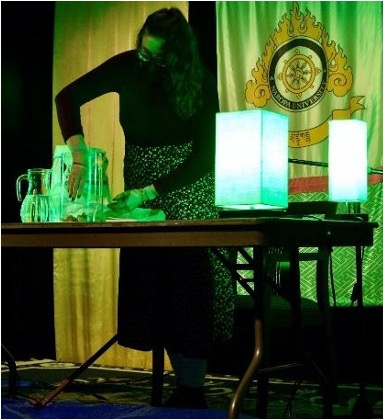
image description/alt text: a vibrant green, similar to the color of lime jello, lights up a room and the photo. lauren samblanet, a white gender fluid person with long brown hair, wears glasses, a mask, a dark sweater, and a flower skirt. they are standing behind the table on the stage with green lights on it, gently dropping stones into the large glass vase.
          it's a strange thing to read a book and be charmed and inspired by it while also being disturbed by the ableism lapping through its pages. but perhaps, it’s when we have something to push back against that we are most likely to create something.

          marina adores long-duration performance art. she sees pain as the ultimate portal to knowledge. once a commitment is made – that she and ulay will perform a piece for 16 days – it cannot be broken, even though ulay had health challenges during those 16 days.

          she writes, “you must be really exhausted, to the point where there’s nothing left: where you’re so tired that you can’t take it anymore. when your brain is so tired of working that it can no longer think – that’s the moment when liquid knowledge can enter” (Abramovic 138).

          she goes on, “we want to break the physical body. we want to experience a different mental state…i see this work and the 16 days as a discipline” (Abramovic 141).

          and a few pages earlier, she says, “but if you don’t move, if you have the willpower to make no compromise or concession, the pain becomes so intense that you think you’ll lose consciousness. and it’s at that moment – and only at that moment – that the pain disappears” (Abramovic 136).

     writers are always writing about the body.                 the body.
          not my body, not this very real body, but this intellectualized idea of a body. we want to write theory about bodies and trauma, about bodies and language, about bodies and pain, about bodies and illness. but do we really want to be in our bodyminds? be with our bodyminds? do we only want to think about the bodymind or are we okay with the material fact of bodyminds – with how messy they are, with how much pain and pleasure they can bring us, with their senses and sensory overwhelm, with how illness can render our bodyminds forever changed?

          while processing what marina tells me, my bodymind dreams up inter-related performances that center on the color green, the color of my migraine light bulb that paints the room a vibrant green, much like lime jello. at the top of my performance notes for these green performances i write:

          marina talks about performance needing endurance because longer durations deliver us into these states we cannot reach otherwise and how enduring pain is part of the work of performance and part of what delivers us to these states / for one living with chronic pain/illness, isn’t endurance a constant? just like the pain. chronic illness delivers us to states otherwise not accessible, for good or for bad. isn’t, then, being chronically ill the longest duration performance art there is? what separates living from performance, anyway? how can performance create less suffering? how can performance instead deliver us to states where we access a deeper care for ourselves and others than usual?

          when my bodymind is in pain, when i am so exhausted i can’t take it anymore, acceptance does not render me healed or rejuvenated. i am not, cannot, be the type of artist who believes that we must suffer to make our art. i will not force my bodymind to be in even more pain or to be even more fatigued than what we already must endure. i do not want to exile my parts to create art or to process having made art that is now public, art that i must keep delving into even as it triggers me. i do not want to harm my bodymind or my parts or my community for the sake of art.
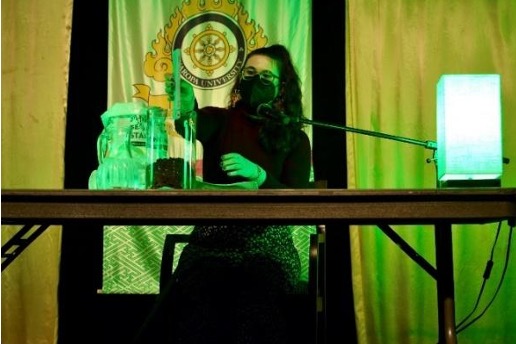
image description/alt text: a lime-green tinted photo of lauren sitting and holding a copy of her book, like a dog. they are slowing lowering the book into the vase that is filled with dirt.
         my disabled bodymind on a stage. my bodymind in pain, slumped against the wall, on the floor, wrapped in blankets. maybe she reads from her book or maybe they read something new. part way through they begin weeping. she rips up what they are reading, they talk about how it harms her. but then something else.

                                  not to create an exile.
to love the one who wrote the book that they needed to write as a way of surviving, as a way of finding others like her.
          one night, i go on a sort of journey with my partner, guided by plant medicine. my body collapses into surreal levels of pain and nausea. lying on the floor, unable to move, under blankets, with my heating pad and my stuffies, the room goes rainbow pastel and it feels like i’m in another galaxy. at one point my partner asks me if i think the universe cares about us or any living beings. what can i say? i am a tender-hearted autistic, who will not accept cynicism nor conventional notions of all-powerful gods. still, i believe we humans know almost nothing, and that there is some force we cannot understand, a force that cares. my partner asks how the universe can care when even in nature, some creatures must die for others to live. he goes on to say that predatory animals first kill the sick and disabled prey. i am ensnared by what he says and he holds me through this experience with great care. he mentioned an alligator so i see myself and my disabled friends as fish in my minds eye. moments later i’m weeping thinking of this and the memory of the medical trauma from my last ER visit.

          i think about how marina wants us to break our bodies for our art. i think about how everyday more palestinians become disabled during the genocide and i think of the stories of disabled palestinians who are murdered by israeli forces. i think about how many people who are experiencing homelessness are disabled, and how homelessness disproportionately impacts BIPOC and queer and trans people. i think about how few people still care about covid, how once the government said the virus will only kill elderly people and disabled people, most people stopped paying attention, stopped taking precautions. i think about how marina wants us to break our bodies for our art and i think about how abled people tell those of us who are disabled that our bodyminds are broken.
our bodyminds are not broken.
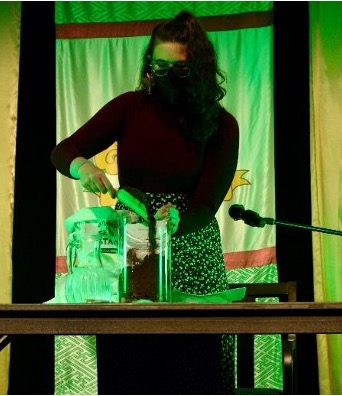
image description/alt text: a lime-green tinted photo of lauren standing behind the table with the green lights. she is holding a shovel and shoveling dirt on top of their book in the glass vase.
          they try to revive the book, suturing the pieces back together, planting the pieces in a pot, covering them with dirt, filling the pot with water. crying still, in pain and so tired from the pain, from the harm, from the repair.

          she lies down, crying, but now others come forward and pull her blankets up around them. they carry plants, green, very green and place them around her. they press play on a recording of birds or bubbling water. someone switches off the lights. someone else turns on a lamp with a green light bulb in it. she puts her legs up the wall and someone weaves a green vine around their legs. she rests and as they rest a video starts :

a meadow.      a bed in a meadow.      a bath in a meadow.           many baths in a meadow.
i wrote a book about recovering from sexual assault as a way to survive and yes, there is a part of me who is retriggered each time i read that book, and yes, that part wants to burn the book, and yes, the part of me who wrote this book to survive was so wise to try to live and so brave to reach out from their place of deep suffering and to say to other sexual assault survivors, yes, this happens and no, it shouldn’t happen and no, you don’t have to hold this alone any longer, and
yes, there is the fact that my bodymind, my real, physical bodymind, is in pain and is ill and is so deeply fatigued and yes, i know that the trauma likely renders my illnesses worse, and yes, i know that i am just one in a long lineage of people who lived through trauma whose bodyminds then kept collapsing, and
yes, i am in a long lineage of people who are dreaming up art and writing and performances from their sick beds, and yes, i want to live in a world where we love our bodyminds, not just the theories of our bodyminds we come up with to distance ourselves from the intensity of having bodyminds and from the intensity of the fact that yes, one day, we all will have to part with our bodyminds, and
yes, some days the pain and illness and fatigue are so overwhelming that i, too, have dreamed of giving up my bodymind sooner, but yes, i want to be here and there are so many parts of me that are fighting to survive, and yes, there are so many parts of all of us who scream for us to destroy that actually just need our attention, love and care, and
yes, i am dreaming up a series of green performances that may only ever live on in my mind, but yes, the fact that my bodymind, even in pain and illness and fatigue, wants to dream is a gift, and yes, some days my parts do not want to endure the memory of trauma or the reality of pain and illness any longer, but yes, my parts keep trying to survive regardless, and yes, i want to survive and yes, i want everyone to survive, and yes, i want everyone to have a home, and yes, i want genocide to stop, and yes, i want an end to all forms of systemic violence, and
no, i will not light my book on fire nor will i suffer long duration performance art that my body cannot handle, and yes, i am planting my book in the soil and yes, i am planting seeds alongside my book, and yes, this is a type of destruction and a type of performance also, but yes, i want to see what can grow next, i want to let the part of me who wrote this book release their burden and transform and help me survive, even in pain and illness and fatigue and sensory overwhelm and memory of trauma, and
yes, i want us all to survive, to transform, to lean on the beings and materials that can help us transform, and yes, i want us to transform how we care for one another through trauma and pain and illness, and
no, marina, our bodyminds do not need to be broken to make transformational art.
there is art that embodies care and that is the art i seek. that is the art i dream of from my sickbed, living in the ongoing pain and fatigue that do not dissolve, but that are constantly shifting, that open me to the flow of being right here, right now, performing, writing, creating with my body, learning from my disabled kin, transformed by our refusal to break ourselves any longer.
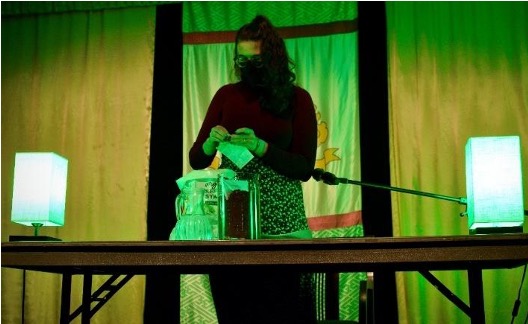
image description/alt text: another lime-green tinted photo of lauren standing behind the table with the green lights. they are opening a package of chamomile seeds, so that they can scatter them into the glass vase that has her book and dirt in it.
NOTE: the photos in the essay document a performance at the Jack Kerouac School of Disembodied Poetics for the 2024 Fall Symposium on Disability Poetics. Photo credit: the photos are by jodie kirschner.
works cited: Abramovic, Marina. Walk Through Walls. New York, Three Rivers Press, 2016.
Find more Arts and Multimedia in this issue of Wordgathering.
Back to Top of Page | Back to Manifestos | Back to Volume 19, Issue 2 – Winter 2025-2026
About the Author
lauren samblanet (they/she) is a hybrid writer who cross-pollinates with other forms of making & other makers of forms. they are disabled, chronically ill, neurodivergent, gender fluid, and queer. she received her M.F.A. from Temple University, and currently resides in so-called Colorado, the ancestral homelands of the Arapaho, Cheyenne, and Ute Nations. punctum books published her first book, like a dog. some of their publications include: A Shadow Map: an Anthology by Survivors of Sexual Assault, FENCE, Just Femme and Dandy, Dreginald, Bedfellows, and the Tiny. lauren is a teacher and guide, offering workshops, creative process support, and creative consulting through their passion project, reinventing creative process.